
What Is a Master Key System?
A master key system (also known as a master-key system, general master key system, or simply a master key system) is a lock system in which a single key can open more than one lock.
Such systems allow you to:
- manage access to premises;
- assign different access rights to different users;
- reduce the number of keys;
- simplify access administration.
Example:
- In a hotel, a guest should only have access to their own room, a housekeeper should be able to open the rooms on their floor, while the manager should have access to all areas.
Without a master key system, this means dozens or even hundreds of keys. With a master key system, access is organized in a logical and convenient hierarchy.
Types of Master Key Systems
Single-Level Master Key System
A system with one master key level.
Each lock has its own individual key, and one master key opens all locks.
Examples:
A small hotel:
- the manager can open every room; guests can only open their own room.
An office:
- employees have access only to their assigned rooms;
- the manager and cleaning staff can open all doors.
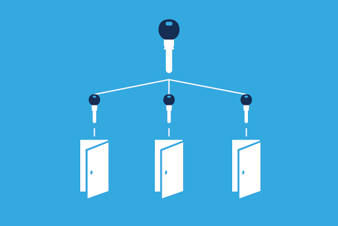
Multi-Level Master Key System
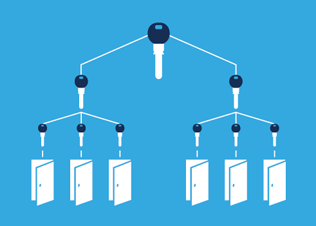
A system with multiple levels of access.
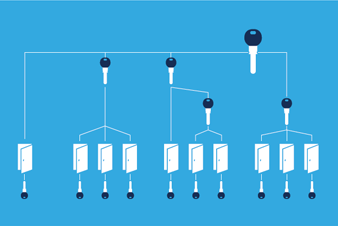
It includes master keys for individual groups of locks and a grand master key that opens every lock.
A typical hierarchy may include:
- a master key for Group A;
- a master key for Groups A and B;
- a grand master key for all doors.
Examples:
A multi-storey hotel — guests open only their own rooms; staff can access rooms on their assigned floor; the manager can access every room.
An university — individual classroom keys; faculty master keys; a grand master key for the entire campus.
Common Door Systems
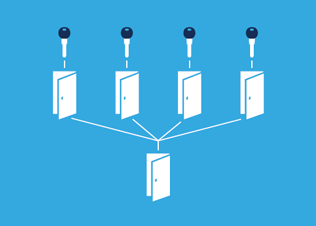
In these systems, there may be no master key, but certain doors can be opened by all keys or by a defined group of keys.
Examples:
- an office — employees can open their own office, the main entrance, and the kitchen.
- An apartment building — an apartment key opens the building entrance but not neighboring apartments or other building entrances.
Mixed Systems
These combine master keys with common doors.
Examples:
- A large office — employees open their offices, the building entrance, and their floor; department managers open all offices within their department, the building entrance, and their department floor; the director has access to all areas.
- A hotel — guests have access to shared facilities such as the SPA and conference rooms; staff have access to common service areas.
Keyed-Alike Systems
All locks are keyed identically and can be opened with the same key.
Examples:
- a front door and a mailbox;
- technical rooms in an office building.
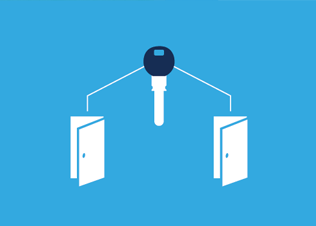
Important: Strictly speaking, keyed-alike systems are not master key systems because they do not provide hierarchical access.
Custom Master Key Systems
These systems have no strict hierarchy or predefined logic and are typically used for private properties.
Example:
- the owner has a key for every door; the driver only has access to the garage at the country house; the nanny has access to the apartment; the gardener can open the gate and utility buildings at the country house.
Master Key System Pricing
The cost depends on:
- the number of doors and keys;
- the selected cylinder model.
For large keyed-alike systems, cylinder prices may start from approximately €8–9 per cylinder.
Complex hierarchical master key systems are priced individually.
If you would like an accurate quotation, simply describe your requirements, and we will recommend the most suitable solution.
You can also view some of our completed master key systems in the Completed Projects section.
Master Key Systems Using M&C Cylinders
M&C cylinders make it possible to build both simple and highly complex master key systems while providing excellent reliability and protection against unauthorized key duplication.
All M&C cylinders support keyed-alike configurations.
Hierarchical master key systems can be implemented using:
The M&C product range also includes cylinder systems specifically designed for advanced master key applications.
If you need a master key system, describe your requirements, and we will recommend the most appropriate configuration.
Mechanical vs. Electronic Master Key Systems: Pros and Cons
Costs
Mechanical systems are generally less expensive to purchase.
However, if a key is lost, replacing cylinders may be necessary, which can significantly increase the total cost of ownership. In some cases, electronic systems become the more economical option.
With an electronic system, a lost key or credential can simply be removed from the system.
Reliability
High-quality mechanical systems can operate reliably for decades.
Many electronic systems have not yet accumulated comparable long-term service records.
Electronic systems depend on power supplies, batteries, and environmental conditions, whereas mechanical systems operate independently and are generally less sensitive to external factors.
Flexibility
Mechanical systems have a fixed access structure.
Electronic systems allow access rights to be changed without replacing hardware.
Access Control
Mechanical systems cannot:
- limit when a key is valid;
- record opening events.
Electronic systems provide these features.
Security
High-quality certified mechanical and electronic systems offer a comparable level of physical security.
However, electronic systems may introduce software-related vulnerabilities.
Frequently Asked Questions
Is a lock in a master key system less secure?
Generally, yes. All else being equal, a master-keyed cylinder is typically easier to decode or pick than a non-master-keyed cylinder.
For this reason, it is important to use cylinders specifically certified for master key systems.
Can the system be expanded later?
Yes, especially if future expansion is considered during the initial design stage.
It is recommended to reserve expansion capacity from the beginning.
What happens if the master key is lost?
In most cases, all cylinders opened by that master key must be replaced.
Master keys should therefore be subject to strict control.
How many doors can be included?
In theory, there is virtually no limit—from just a few doors to hundreds of thousands.
The system can also include mailboxes, cabinets, furniture locks, elevator control locks, and many other types of locking devices.
In practice, the maximum size depends on the selected cylinder system and keying design.
Can keys be protected against unauthorized copying?
Yes.
When using cylinders with protected key profiles, duplicate keys can only be produced after proper authorization.
How should a master key system be designed?
The first step is to determine:
- who should have access to which areas;
- how many levels of access are required.
The system is then designed specifically for your building and operational requirements.
Need a Master Key System?
Describe your property and access requirements, and we will help design the right master key system and recommend the optimal solution.